
[PLS1] Optimization of antibiotic therapy in the ICU

Professor Jeffrey Lipman received his medical degree (MBBCh) from the University of Witwatersrand, South Africa and has specialist qualifications in anaesthesia (DA, FFA) and intensive care (FFA Crit Care, FCICM).
Professor Lipman is Professor and Head of Anaesthesiology and Critical Care, University of Queensland and also is the Executive Director of the Burns, Trauma, Critical Care Research Centre at this University. He has Professorial attachments at QUT, University of New South Wales, Chinese University of Hong Kong and his Alma Mater, University of Witwatersrand.
He is a career Intensivist, having worked full-time in Intensive Care Units since 1979. His research interests include all aspects of infection management in intensive care. He has a special interest in the pharmacokinetics of antibiotics, an area in which he completed his MD through the Chinese University of Hong Kong where he still holds an Adjunct Professorial position.
He has published over 30 book chapters and over 500 peer-reviewed articles including in high impact journals like NEJM, JAMA and Lancet Infectious Diseases.
He has been an invited speaker to over 100 Congresses Nationally and Internationally, being a Keynote speaker in many countries around the world.
Optimizing antibiotic exposure involves understanding pharmacokinetics of the drug (PK – what the body does to the drug) as well as the effect the drug has within the body on bacteria ie pharmacodynamics.
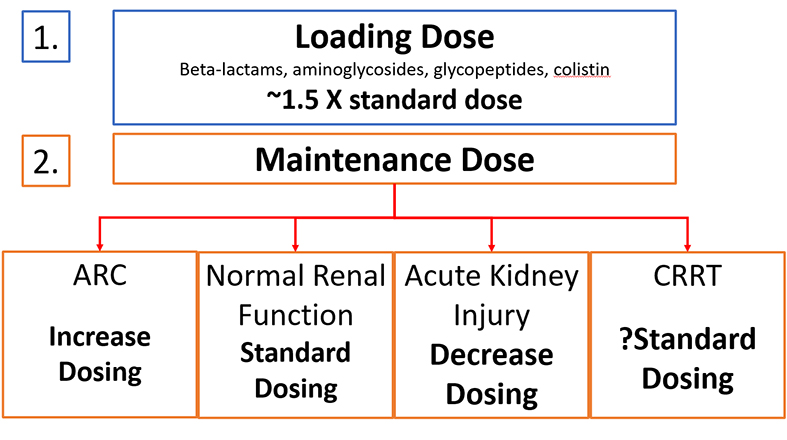
Drug discovery and subsequent release for marketing involves phase 1, 2 and 3 studies which usually don’t involve ICU patients. Critically ill patients have different haemodynamics to the studied patients, often have low serum proteins and often increased volume of distributions of hydrophilic antibiotics. I will be stressing the need to give a loading dose of many of the antibiotics and then discuss issues related to clearances of these agents, as many ICU patients have augmented renal clearances. When using renal replacement therapies in the ICU drug clearances are even more complicated. In this talk I will describe these alterations, stressing how I approach dosing in the ICU.
I will also describe many of the issues of the denominator of the equation of PK/PD and specifically go into the problems and inaccuracies of measurement of bacterial MICs and then the adjustment of pharmacokinetic parameters to overcome rising MICs.
REFERENCES
1. Intensive Care Med. 2013 Dec;39(12):2070-82. doi: 10.1007/s00134-013-3088-4
2. Int J Antimicrob Agents. 2013 Feb;41(2):162-6. doi: 10.1016/j.ijantimicag.2012.10.002
3. J Antimicrob Chemother. 2018 Mar 1;73(3):564-568. doi: 10.1093/jac/dkx427
Drug discovery and subsequent release for marketing involves phase 1, 2 and 3 studies which usually don’t involve ICU patients. Critically ill patients have different haemodynamics to the studied patients, often have low serum proteins and often increased volume of distributions of hydrophilic antibiotics. I will be stressing the need to give a loading dose of many of the antibiotics and then discuss issues related to clearances of these agents, as many ICU patients have augmented renal clearances. When using renal replacement therapies in the ICU drug clearances are even more complicated. In this talk I will describe these alterations, stressing how I approach dosing in the ICU.
I will also describe many of the issues of the denominator of the equation of PK/PD and specifically go into the problems and inaccuracies of measurement of bacterial MICs and then the adjustment of pharmacokinetic parameters to overcome rising MICs.
REFERENCES
1. Intensive Care Med. 2013 Dec;39(12):2070-82. doi: 10.1007/s00134-013-3088-4
2. Int J Antimicrob Agents. 2013 Feb;41(2):162-6. doi: 10.1016/j.ijantimicag.2012.10.002
3. J Antimicrob Chemother. 2018 Mar 1;73(3):564-568. doi: 10.1093/jac/dkx427